
|
Report of artist’s residency at AHPCC and ATC
Jack Ox and David Britton |
|||||
|
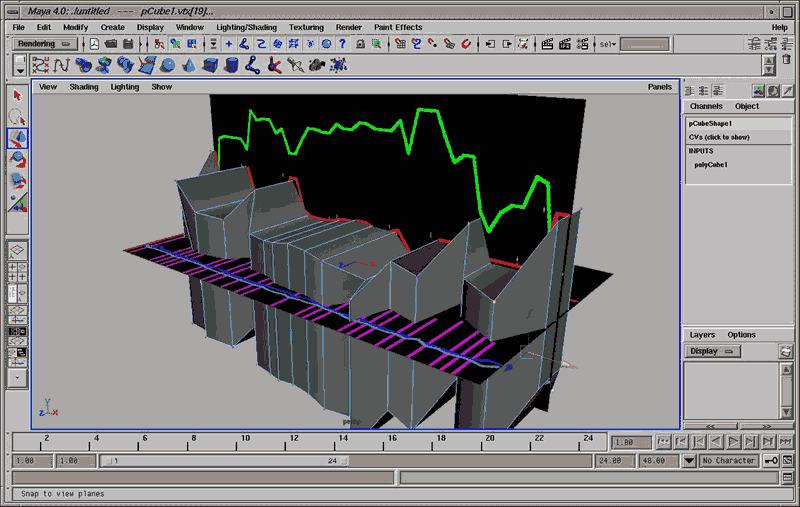
When we came to AHPCC we had a two-fold purpose: 1. Jack Ox, the artist half of our collaboration, needed to work out a process for modeling into 3d objects the information (pitch and loudness) derived from 180 different sound files supplied by Alvin Curran, the composer who is organizing the music of our future “Gridjam”, and 2. We wanted to experiment with sending these files to Boston on the AccessGrid. The technical support which I was provided was excellent. Chris Davis, our assigned graduate student, was able to understand what I needed and actually taught me to do it myself in Maya. I have been empowered in an incredibly significant way during the residency. And we have determined that because we must make some money back on this project, we cannot utilize student workers on Maya. As I am now prepared to accomplish the entire task with my own hands is very important, and the best solution for the problem. It is actually a good thing for the work when I embark on large and repetitive tasks. I believe that technology should be combined with hand work, i.e. the hand drawn texture maps laboriously produced with pencil and paper over orthographic views of landscape models. Now, during the long process of making 180 models the subtleties of difference and sameness in the sounds and their models will become defined in this visual language as I think with my hands. Unfortunately, the attempt on the AccessGrid was not so successful because programming was not prepared in time so that we were able to send the new objects during our AccessGrid time slot.. We could have achieved this, except that the connection between the Viz Lab and the AG rooms were cut when everything else was working. Tom Caudell said “that’s research” and I expect he is right. Below you can see a model of the sound made by bison. The green line maps the changes in dynmamics (loud/soft) and the red line maps pitch changes. The model is scaled smaller for soft and wider for loud. It is then shifted up and down from the other direction to reflect pitch changes. |
|||||
 |
|||||
